
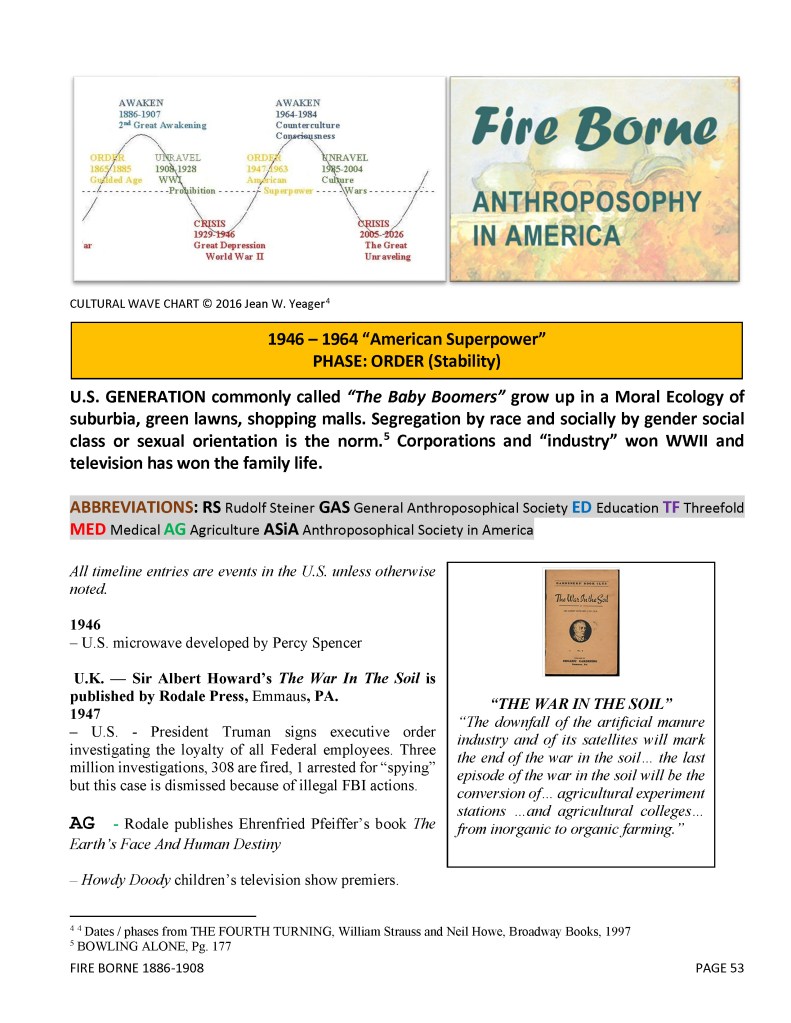
“AMERICAN SUPERPOWER” – PHASE “Order (Stability)
U.S. GENERATION commonly called “The Baby Boomers” grow-up in a Moral Ecology of suburbia, green lawns, and shopping malls. Segregation by race and socially by gender social class or sexual orientation is the norm. Corporations and “industry” won WWII and television has won the family life.
1956 TWO COURAGEOUS BIODYNAMIC GARDENERS SUE NEW YORK STATE
FROM A BIODYNAMIC ASSOCIATION FLYER DISTRIBUTED IN WHOLE FOOD STORES
Next year (2006) will mark the 50th anniversary of an act of state-supported environmental pollution which prompted outrage and resistance by two Biodynamic gardeners and eventually led to a worldwide change in consciousness.
In 1956, the state of New York, in an effort to stop a plague of fire ants, conducted wide-spread and indiscriminate aerial spraying of DDT mixed with fuel oil (so that it would adhere better) on Long Island, New York. Mary T. Richards and Marjorie Spock (sister of the noted Pediatrician, Benjamin Spock) whose garden on Long Island had been tended for many years in a non-chemical, Biodynamic fashion, sued the government to stop the spraying and for damages.
The case went to trial in Long Island, and Richards and Spock made sure that the shocking misuse of pesticides by the government filled the local newspapers. Richards and Spock brought together a wide-range of scientific experts in documenting the enormous damage that pesticides had done to fish, birds, wildlife, dairy cattle, gardens, livestock, and perhaps to children.
The enormous press coverage caught the attention of Rachael Carson who, at that time, was just beginning her research into the effects of pesticides. Carson attended the trial and soon became friends with Richards and Spock who, when they found out about her scientific and literary background, provided Carson with transcripts and research data which they had assembled for the trial. As Linda Lear an environmental historian puts it: “It (the trial) provided Rachel Carson with ‘mountains of material,’ important collaborators such as Mary Richards and Marjorie Spock, and a wealth of expert contacts in medical and agricultural fields previously unknown to her.” (Lear)
“Silent Spring (published in 1958) indicted the chemical industry, the government, and agribusiness for indiscriminately using pesticides… There are very few books that can be said to have changed the course of history, but this was one of them. It polarized government, science, and industry, and made people stop in their tracks and see the world in a new way. With its publication, ‘ecology’ became part of everyday vocabulary.” (Lear) It took the U.S. government until 1972 to ban the use of DDT in the United States.
[1] BOWLING ALONE, Pg. 177
https://firebornecom.blog/wp-content/uploads/2022/02/1-4pg-b-d-and-silent-spring WOULD BE AVAILABLE
1958 PFEIFFER — THE UN-NAMED EXPERT WITNESS
https://firebornecom.blog/wp-content/uploads/2022/02/1958-pfeiffer-the-unnamed-witness WOULD BE AVAILABLE
“In 1958 Rachel Carson wrote Spock and Richards in February at a time when they were preparing evidence for the trial. At least 57 letters have survived from Carson to Spock and Richards. The letters have subsequently been deposited at the Beneke Rare Book and Manuscript Library, Yale Collection of American Literature, of Yale University.”
In a letter Carson writes “many thanks for the… Very excellent Pfeiffer paper… With its many references. It is a gold mine of information” (Carson, 1958). In the same letter, Carson states “You have been so enormously helpful to me, and apparently are so familiar with the vast amount of material.” (Carson, 1958).
‘The “Goldmine” to which Carson refers was the Winter issue of Bio-Dynamics, #45.
“Many of the references and authors cited by Pfeiffer later reappeared in Carson’s reference list. Of one of his references (viz., Read, and generally, 1956), Pfeiffer (1958) commented, “this is one of the most comprehensive reports, with almost 1000 references” (page. 19 39). It reappeared in Carson’s references. In her exchanges with Spock, Carson makes multiple references to Pfeiffer to his correspondence. With Spock and Richards as intermediaries Pfeiffer was queried by Carson about sources, references, and his own tests and experiments, although he received no acknowledgment in Silent Spring.”
Pfeiffer also appeared as an expert witness in the Long Island Spray Trial (Spock and Richards, 1962). When he was challenged by a defense attorney as to what fee he was receiving, he responded that no fee was involved; and when further challenged as to why he was there, he risked responded, “because I am interested in the future of the human race” (page. 25).
NOTES:
- Environmental History Review 17 (Summer 1993): 23-48, Linda J. Lear, University of Maryland, Baltimore County.
http://www.history.vt.edu/Barrow/Hist3706/readings/lear.html

Until January 15 –
$5 Pre-Publication Discount
GET THE DISCOUNT COUPON CODE FROM THE PUBLISHER’S WEBSITE
ANTHROPOSOPHICAL PUBLICATIONS https://anthroposophicalpublications.org
 FIRE BORNE: Anthroposophy in America